Dynamic Springback Compensation in CNC Pipe Bending – Solving Bending Angle Deviation Across Diverse Tube Alloys
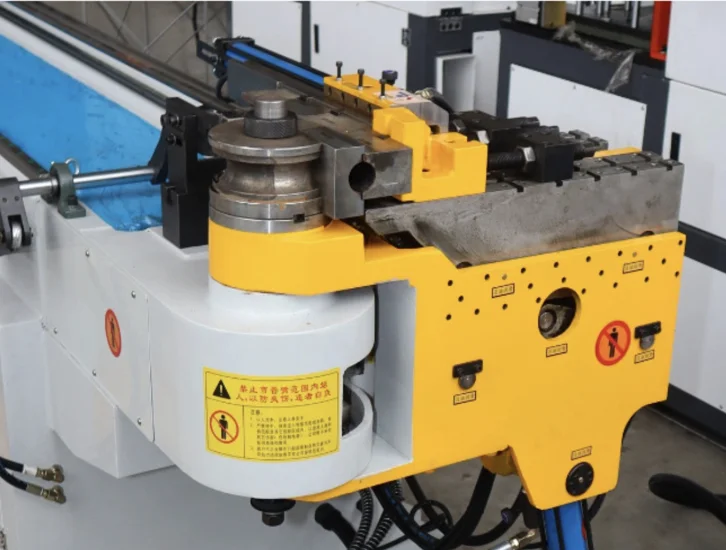
Springback is the primary cause of angle deviation in CNC tube bending. This technical article analyzes the metallurgy behind springback, mathematical prediction models, and the integration of real-time sensor feedback.
In industrial tube fabrication, achieving a precise bending angle on the first attempt is a common engineering challenge. When a CNC pipe bending machine bends a metal tube, the outer wall stretches in tension while the inner wall compresses.
Once the bending tooling releases the tube, the metal undergoes elastic recovery, partially returning to its original shape. This physical phenomenon is known as springback. Without precise compensation, springback leads to dimensional errors, causing parts to fail strict inspection standards in industries like automotive exhaust systems, aerospace piping, and structural handrails.
The Physics of Tube Springback
1. Metallurgical Factors of Springback
Every metal alloy has an elastic region and a plastic region. Bending requires pushing the metal past its yield strength into the plastic deformation range so that it retains its new shape. However, because some elastic stress remains in the bent section, a small amount of elastic recovery is inevitable. The magnitude of springback ($\Delta\alpha$) depends on:
- Material Yield Strength ($\sigma_y$): High-strength materials (such as stainless steel or titanium) exhibit much larger springback than mild carbon steel or aluminum.
- Tube Wall Thickness ($t$) and Diameter ($D$): Thin-walled tubes with large diameters bend with less constraint, resulting in higher springback.
- Bending Radius ($R$): Larger center-line radii (CLR) increase the volume of material undergoing elastic stress, leading to more springback.
2. Springback Prediction Model
To estimate the final bend angle, engineers calculate the springback ratio ($K_s$), which relates the loaded bend angle ($\alpha_i$) to the unloaded, final bend angle ($\alpha_f$). The simplified springback formula is:
Ks = αf / αi = 4 × (R × σy / (E × D))3 - 3 × (R × σy / (E × D)) + 1
Ks: Springback factor (≤ 1)
R: Center-line bend radius (mm)
σy: Material yield strength (MPa)
E: Modulus of elasticity (MPa)
Methods of Springback Compensation
Traditional workshops relied on trial-and-error, where operators manually overbent the tube by a few degrees based on experience. While this works for simple parts in small batches, it is highly inefficient for high-volume B2B contract manufacturing.
1. Database-Driven Lookup Tables
Modern CNC control systems use pre-programmed material databases. The operator selects the material type, tube diameter, wall thickness, and bend radius. The controller looks up the corresponding springback value from a calibrated lookup table and automatically adjusts the bending arm stroke (e.g., programming a 93° stroke to achieve a final 90° bend).
2. Closed-Loop Real-Time Measurement Systems
Advanced CNC pipe benders integrate real-time, contact-free angle measurement sensors (such as laser or optical profile sensors). The bending cycle follows a multi-step sequence:
- Initial Bend: The bending arm rotates the tube to the target nominal angle (e.g., 90°).
- Unclamping & Measurement: The pressure die retracts slightly to allow the tube to spring back. The sensor instantly measures the actual relaxed angle.
- Re-bend (Compensation): The controller calculates the difference (e.g., the tube sprang back to 86.5°, indicating a 3.5° springback). The bender automatically re-clamps the tube and applies a second, precise overbend stroke to hit the exact 90° target.
Comparison: Open-Loop vs. Closed-Loop Bending
To assist production managers in choosing the right equipment configuration, the table below highlights the performance differences between open-loop and closed-loop compensation systems:
| Technical Parameter | Database Open-Loop System | Sensor-Based Closed-Loop System |
|---|---|---|
| Control Principle | Look-up table approximation | Real-time sensor measurement & feedback |
| Angle Accuracy | ±0.5° to ±1.0° (depends on material consistency) | ±0.1° to ±0.2° (highly consistent) |
| Setup Time | Medium (requires test bends for new batches) | Zero (automatically adapts to new batches) |
| Material Variations | Vulnerable to variations in yield strength | Compensates automatically for coil batch differences |
| Scrap Rate | 2% to 5% during initial batch setups | < 0.5% (first-part-right capability) |
Operational and B2B Financial Impact
Implementing a CNC pipe bender with closed-loop springback compensation directly solves major pain points for industrial shops.
1. Eliminating Batch-to-Batch Setup Waste
Even within the same grade of steel (such as AISI 304 stainless steel), mechanical properties vary between material batches from different mills. A change in carbon content or annealing temperature alters the yield strength, which shifts the springback.
Without closed-loop monitoring, this variance forces operators to stop production, run test bends, and adjust programs for every new pallet of material. With dynamic compensation, the machine measures the actual springback of each individual tube and corrects it automatically, eliminating setup scrap entirely.
2. High-Value Tube Fabrication Protection
In industries using expensive alloys like titanium, inconel, or thick-walled copper-nickel profiles, a single scrapped bend can cost hundreds of dollars in material. Pushing scrap rates down to near-zero provides immediate financial return, often recovering the added cost of sensor-based systems within a few months of operation.
Technical Consultation and Engineering Support
At RAXMEK, we build our CNC pipe bending machines with heavy-duty cast frames, high-precision hydraulic servo valves, and advanced PLC control cabinets to ensure reliable performance in demanding manufacturing environments.
Our engineers are ready to help you optimize your tube bending department. We offer:
- Custom Tooling Configuration: Designing custom bend dies, clamp dies, and mandrels for your specific tube profiles.
- Material Bending Analysis: Send us your sample tubes, and we will conduct bending trials to generate accurate springback profiles and surface quality reports.
- Detailed Quotes: Complete, transparent quotations including machine capacity specifications, multi-stack options, and loader integrations.
Contact RAXMEK today to consult with our engineering support team and improve your production efficiency.
Похожие ресурсы
CNC Press Brake Crowning Systems – Hydraulic vs. Mechanical Deflection Compensation for High-Precision Metal Bending
In precision sheet metal bending, frame deflection directly affects angle consistency across the bending length. This article examines the mechanical differences, PID feedback...
CNC Press Brake Backgauge Systems – Comparing Multi-Axis (X, R, Z1, Z2, X1, X2) Drive Configurations and Their Impact on Bending Accuracy
A deep dive into press brake backgauge axes, drive kinematics, and linear transmission systems. Learn how multi-axis (X, R, Z1, Z2, X1, X2) setups improve production speed...
Mandrel Selection and Placement Kinematics – Preventing Wrinkling, Ovality, and Wall Thinning in Thin-Walled Tube Bending
High-quality tube bending requires careful management of internal and external forces. This article explores mandrel types, wiper die settings, and mandrel insertion depth...